

The Reason You Keep Lowering Your Standards Has a Name — And It’s Not What You Think
THE STANDARD SERIES — PART 5 OF 5
The final post in a foundational reading series for women who are ready to stop living on inherited settings. If you missed Parts 1 to 4, begin there. This ending lands best when you have read the rest.
There is a moment before a woman lowers her standard that rarely gets discussed properly. It is not usually dramatic. It does not always look like a breakdown in judgment. It often looks much more ordinary than that. A text she knows she should ignore. A behaviour she already noticed and mentally flagged. A conversation where she feels herself beginning to explain away what she previously said mattered. A situation she had been clear about in private, but becomes strangely flexible about in real time. And in that moment, it can feel confusing, because she knows better. She has read enough, reflected enough, healed enough, and promised herself enough times to know that this is not aligned. And yet something in her starts rearranging the truth.
That is the part I want to name clearly in this final post. Because women are often much too vague with themselves about why they keep lowering the standard. They say they were lonely. They say they got caught up. They say they were trying to be understanding. They say they did not want to be too rigid. They say they were just seeing where things go. They say they did not want to overreact. But beneath all of that, there is usually a more exact answer.
The reason you keep lowering your standards has a name.
And that name is emotional prioritisation.

That is what this usually is. In the moment of decision, something else becomes more emotionally persuasive than the standard itself. Attention. Chemistry. Relief. Validation. Familiarity. Hope. The fear of losing momentum. The fear of seeming difficult. The fear of being alone again. The desire to keep the feeling going a little longer. The wish that this time, maybe, the almost will become enough.
And because that emotional pull is happening in real time, it can feel more urgent than the standard, which was usually built in private, in clarity, in distance, in thought. That is why women so often shock themselves. Not because they do not know. But because what they know is getting outranked by what they feel.

You Are Not Lowering the Standard Randomly
This is important, because if you keep treating the pattern like random weakness, you will never actually stop it.
Women do not usually lower their standards for no reason. They lower them in exchange for something.
Sometimes it is the temporary relief of not having to walk away.
Sometimes it is the comfort of being wanted.
Sometimes it is the pleasure of chemistry.
Sometimes it is the emotional high of possibility.
Sometimes it is the hope that maybe they are being “too harsh” and this person deserves more time.
Sometimes it is simply that disappointment feels heavy and denial feels lighter for a few more days.
That exchange matters.
Because once you understand that you are not simply “lowering the standard,” you are trading it, the whole conversation becomes clearer. The real question is no longer “Why do I keep doing this?” The real question becomes “What am I accepting in exchange for the collapse?”
That is where honesty starts.

Most Standards Collapse in the Presence of Emotional Hunger
This is the part many women do not want to say out loud because it sounds too vulnerable. But emotional hunger changes perception.
A hungry woman will call crumbs potential.
A lonely woman will call inconsistency complexity.
A tired woman will call poor treatment a rough patch.
A hopeful woman will call repeated patterns misunderstanding.
A woman who deeply wants something to work will often become very creative in how she interprets what should already be clear.
That does not make her foolish. It makes her human. But if she refuses to name the hunger, it will keep disguising itself as discernment.
And that is dangerous.
Because hunger has a way of softening standards selectively. It does not make you abandon everything. It just makes you flexible in the exact place where you most wanted to be chosen, relieved, loved, reassured, or met.
That is why so many women remain confused. They think they have a general standards problem, when really they have an unexamined hunger problem in a few very specific areas.
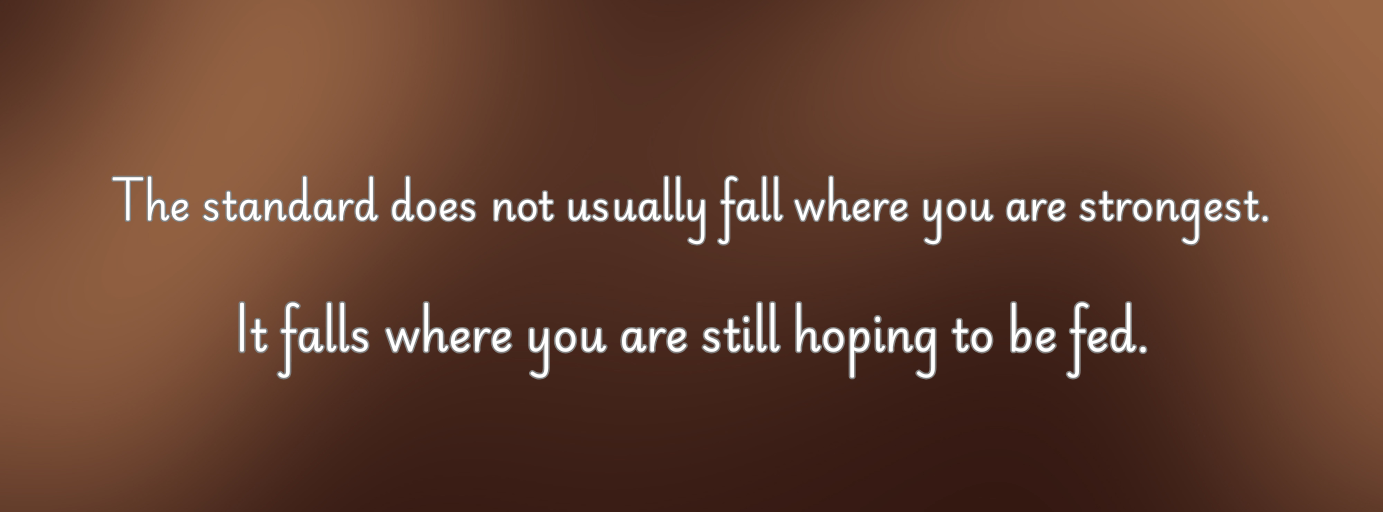
The Standard Usually Falls Where the Self Needs Something
That is why this issue is deeper than discipline.
A woman who is solid in one area can still repeatedly lower the standard in another if that area touches a hunger she has not dealt with honestly. She may be excellent with work, clear with money, disciplined with time, and still become strangely negotiable in love. Or she may be emotionally sharp in relationships and deeply inconsistent with her body. Or polished in public and quietly collapsing in private.
The point is not perfection. The point is precision.
Where does your standard keep falling?
Where do you suddenly become “understanding”?
Where do you become willing to wait longer than you should?
Where do you start performing emotional generosity beyond what the situation has earned?
Where do you keep hoping your clarity will return later, after you have already crossed your own line?
That is the area to watch.
Because the standard usually falls where the self is still trying to get something it has decided feels important.

This Is Why Women Keep Calling Themselves “Too Nice”
A lot of women say they lower their standards because they are too nice.
Usually, that is not the full truth.
They lower their standards because they are trying to preserve access to something they still want.
That is different.
Because niceness sounds like personality. But this is often attachment. Hope. Emotional appetite. Unfinished longing. The need to feel chosen. The desire not to start over. The wish not to lose the possibility completely.
And once that becomes clear, self-awareness becomes much more useful.
Because now a woman can stop flattering the pattern.
She can stop calling it kindness when it is really reluctance.
Stop calling it patience when it is really fear of loss.
Stop calling it discernment when she is actually delaying the truth.
Stop calling it softness when it is really self-abandonment with elegant language wrapped around it.
That is the shift.
Not becoming hard.
Becoming honest.

The Real Work Is Learning What Must Never Be Traded
By this point in the series, that is really what the work has become.
Part 1 named the ceiling.
Part 2 named the credibility problem.
Part 3 named the daily rehearsal.
Part 4 named the inheritance.
And this final post names the trade.
Because that is what lowering your standards usually is: a trade. Your standard in exchange for a feeling, a hope, an opening, a temporary relief, a maybe.
And the woman who is serious about changing her life has to decide what can no longer be traded.
Not because she is cold.
Because she is clear.
This is exactly why The Savvy Sistar Standard matters at the end of this series. Because the book is not simply telling a woman to “have standards.” It is asking her to identify them clearly enough, across body, mind, time, relationships, romance, and money, that she can recognise when she is about to sell one off emotionally for something smaller than what it was built to protect.
Then The Standard Workbook matters because this is the point where honesty has to become written. A woman has to name what she keeps trading her standards for. Otherwise, she stays vague and the pattern stays alive.
And the 10-Week Standard Challenge matters because what should not be traded must be practised repeatedly until the line holds even when the emotion rises.

Before You Go
You do not keep lowering your standards because you are unaware.
You keep lowering them because, in certain moments, something else feels more urgent to protect.
That is the truth.
The attention.
The possibility.
The hope.
The chemistry.
The comfort.
The relief.
The image of what this could become if you just stay open a little longer.
But once you know that, you are no longer helpless in the pattern.
Now you can ask the better question.
What keeps outranking my standard in real time?
Because that is where the work is now.
Not in prettier promises.
Not in another private vow.
In learning what, for the woman you are becoming, can no longer be traded under any emotional condition.
That is how the line begins to hold.
That is how self-respect stops being theoretical.
That is how a standard becomes a life.
Reflect on this before you move on:
What do you keep accepting in exchange for lowering your standard?

Continue after The Standard Series:
Start again at Part 1: The Real Reason You Keep Accepting Less — Even When You Know Better
Download Before the Standard — your first step toward seeing where your life still negotiates what should already be clear
Read The Savvy Sistar Standard
Go deeper with The Standard Workbook
Everything in one place: Beacons
Growth is intentional. It is built over time. And the woman you are becoming cannot keep trading what should have been non-negotiable.
Savvy Sistar 🤎